
EV Home Charger Load Management: The $0 Alternative to a Board Upgrade
A sensor the size of a clothes peg lets a 7kW charger share your supply with the oven, the heat pumps and the hot water. Here is how it works and where its limits are.

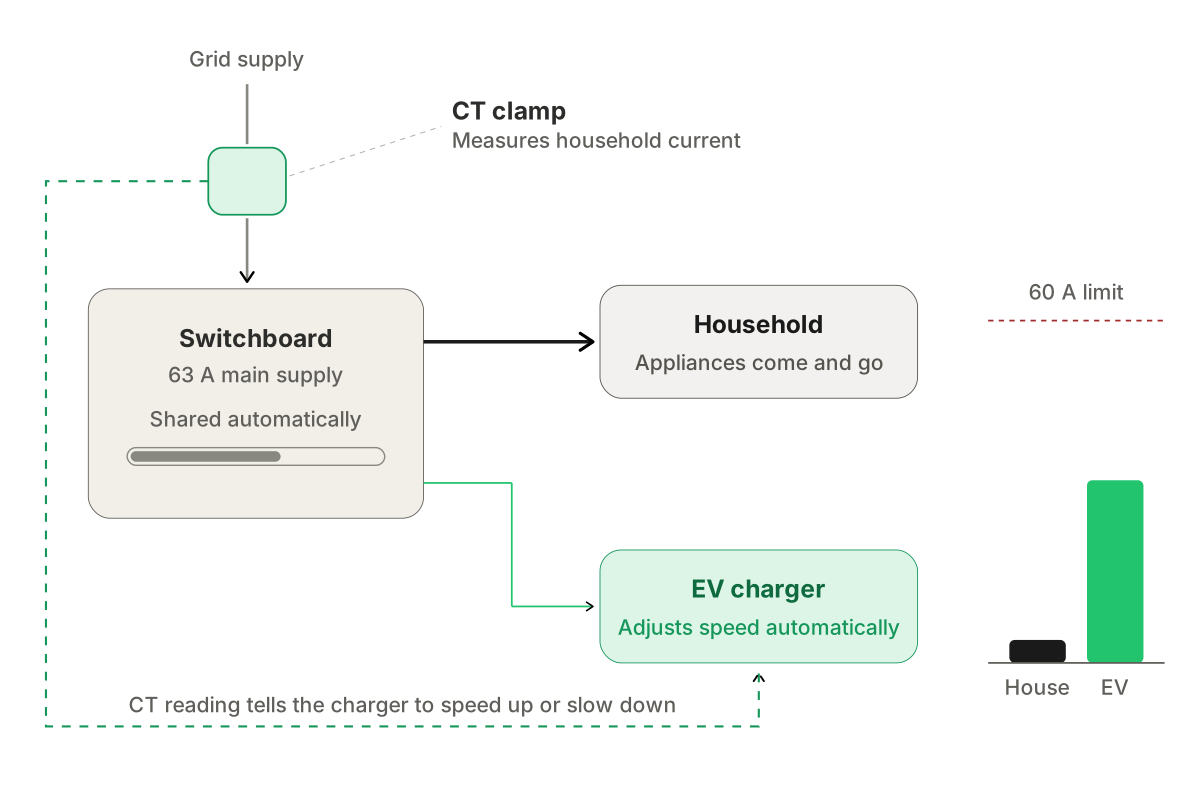
A Papanui Dinner Time, Second by Second
Six o'clock in a 1960s Papanui brick home with a 63A supply. The oven has been on for twenty minutes, both heat pumps are running, the dryer is going and the hot water cylinder has just kicked in. The MG in the garage is plugged into a 7kW charger. On paper that is more than 63A. In practice nothing trips, because the charger is not pulling 7kW. It is pulling 2kW.
A current transformer clamp, a CT clamp, is clipped around the mains cable in the switchboard. It measures total household current every few seconds and reports to the charger. When the house is busy, the charger lowers its rate. When the dryer stops, it goes back up. At 10pm, with the house asleep, it is back to the full 7kW and the car is full by six. That is dynamic load balancing, or DLB, and the family in that house has not had a single trip in the months since we fitted it.
What an EV Home Charger Does as the House Gets Busy
| What is running in the house | House draw | Charger rate on a 63A supply |
|---|---|---|
| Lights, fridge, TV | ~1kW | 7kW (full speed) |
| Plus one heat pump | ~3kW | 7kW |
| Plus oven and second heat pump | ~7kW | ~5kW |
| Plus induction hob on three elements | ~11kW | ~2kW |
| Everything at once, kettle included | ~14kW | Pauses, resumes within minutes |
Indicative figures for a single-phase 63A supply. The lowest rate an EV accepts is about 1.4kW; below that the charger pauses rather than trickles. Busy periods are short, so the car still finishes overnight.
Load Management Solves Capacity
- A 63A supply that already carries heat pumps, induction cooking and hot water
- New all-electric homes in Halswell, Rolleston or Kaiapoi with modern boards and small mains
- Lifestyle blocks where a bore pump or irrigation shares the supply
- Two EVs on one supply, with Wallbox or Evnex chargers that share a single CT clamp
- Flats and townhouses on a shared or limited supply
Typical saving against a mains or switchboard upgrade: $1,500 to $2,500.
Load Management Does Not Solve Safety
- A board with ceramic rewirable fuses still needs replacing before a charger circuit is added.
- A board with no RCD protection still needs at least an RCBO for the charger, and usually more.
- A board with no physical room and nothing to reclaim still needs an extension or a replacement.
- Mains under 63A, which turn up in some older cottages, are too small to share comfortably and need a supply upgrade.
Load Management Comes Built In on Most of Our Range
Every Evnex has overload protection as standard. The EV Power BCP models, both Smart EV Chargers, the Zappi and TeltoCharge include it. Wallbox calls it Power Boost and needs its power meter fitted at the board, which we include in the quote only when your board or mains call for it. The Tesla Wall Connector shares power between Tesla units but does not watch the whole house, and the EV Power SlimLine and ECO Charge are grid-only units for homes with capacity to spare.
Fitting the CT clamp is part of the standard install, so on most chargers load management costs nothing extra. The comparison table marks which chargers have it.

Think Your Supply Is Too Small? Send Us the Board
Four photos are all we need: your switchboard with the door open, the spot where the charger will go, the path between them and your meter board. One written number comes back, usually the same day.